Q: Are new converts to the LDS Church in the U.S. today, as a class, older than they were in preceding years? Is there any trend data by age groups available? In American Grace, Putnam and Campbell found that young Americans tend to be more tolerant and moderate in their social views than older Americans. The young are more likely to reject the culture, if not the doctrine, of a rigidly conservative religious – political culture. “A growing number of Americans, especially young people, have come to disavow religion. For many, their aversion to religion is rooted in unease with the association between religion and conservative politics,” they wrote. I’m trying to find out if the same phenomenon reported by Putnam and Campbell is impacting the LDS Church.
A: First, thank you for the question.
Second, this is the first time the “experts” have been stumped. Based on the responses received, there are no data available to answer this question. It’s possible that the Church Research Information Division of the LDS Church has some data on this question, but even our contacts inside the Church Research Information Division said they had not looked into this question.
The datasets that exist – primarily US based – that include a fair number of Mormons do not include enough converts to Mormonism over a long enough period of time such that an answer to this question can be derived.
The experts universally agreed that this is an interesting question, but that there are no data to answer it.
Q: I am trying to find vital statistics and church activity statistics for the late nineteenth and early twentieth centuries for Utah. Does anyone have an idea where I might look?
A: We had two very helpful responses.
Armand Mauss suggested that the person asking about this information visit the new LDS Church library and archives in Salt Lake City. While there, contacting Rick Turley would be a good idea as he would know if such information exists. Other scholars who might have information on this would be: Tim Heaton, Tom Alexander, Bill Hartley, and Mike Quinn.
Anne Leahy did a bit of legwork to help answer the question. She found a book titled “Membership of the Church of Jesus Christ of Latter-day Saints by Age and Region, 1910-2000” in the Church History Library. She was kind enough to scan the relevant pages and send them to me digitally. I converted the scans (pdf here) into an Excel spreadsheet, which you can download here. The organization of the data is pretty bizarre as it includes cities, regions, counties and even some states as separate line entries. Even so, it does provide membership information in the US from 1910-1957, when it was compiled. To facilitate interpretation of the data, I added total LDS membership information for 1910, 1920, 1930, 1940, and 1950 from the Church Almanac. Doing so allowed me to calculate the percentage of the membership of the LDS Church that was based in the US during those years (ranges from about 85% down to 79%).
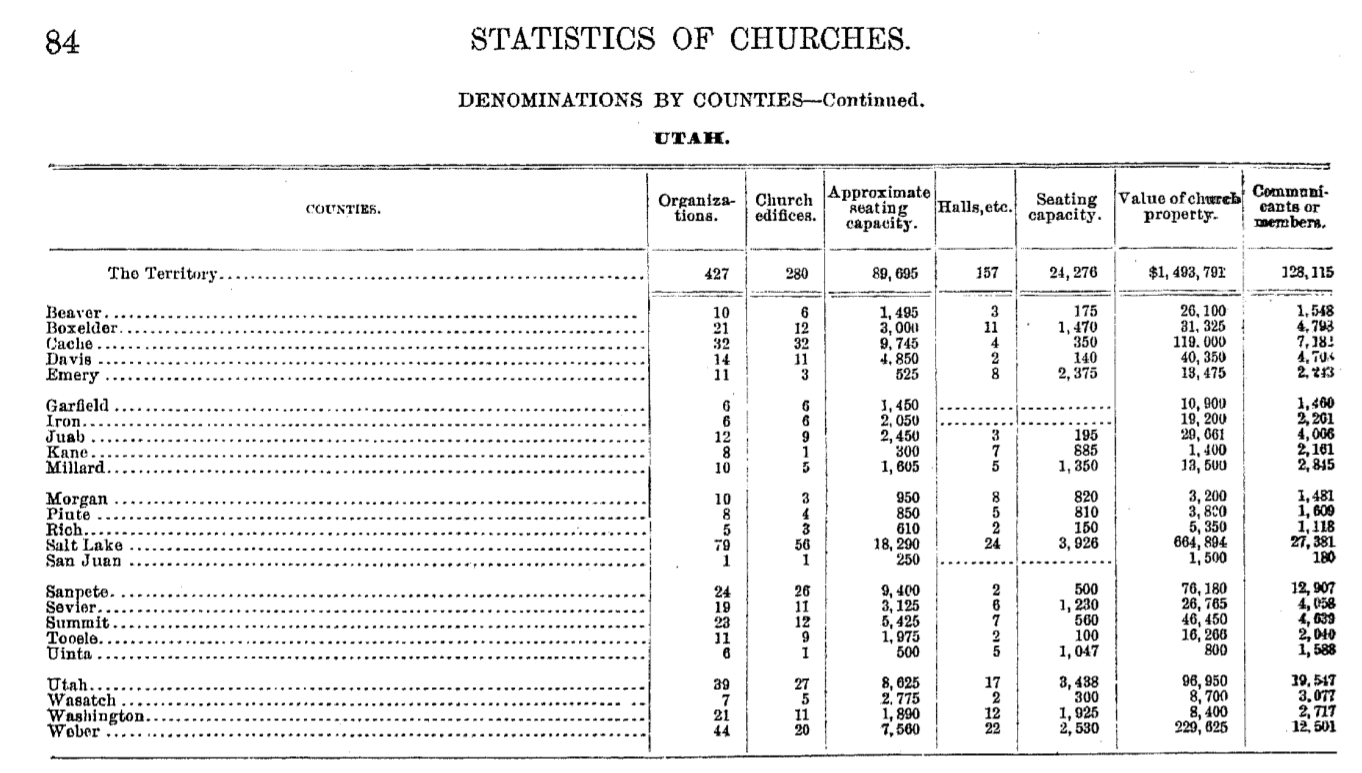
I’m unaware of any other sources specifically on the LDS Church involving membership and vital statistics information. However, there is also some helpful information on the Census Bureau’s website. For instance, in the Eleventh Census of the United States – 1890 – Vol. IX, there is a Report on the Statistics of Churches in the United States. That report provides some information on membership data at the county and state level. Here’s a copy of the number of denominations by county information:
This figure doesn’t indicate the total number of Mormons in Utah, but provides a sense of the number of members, roughly, in the state.
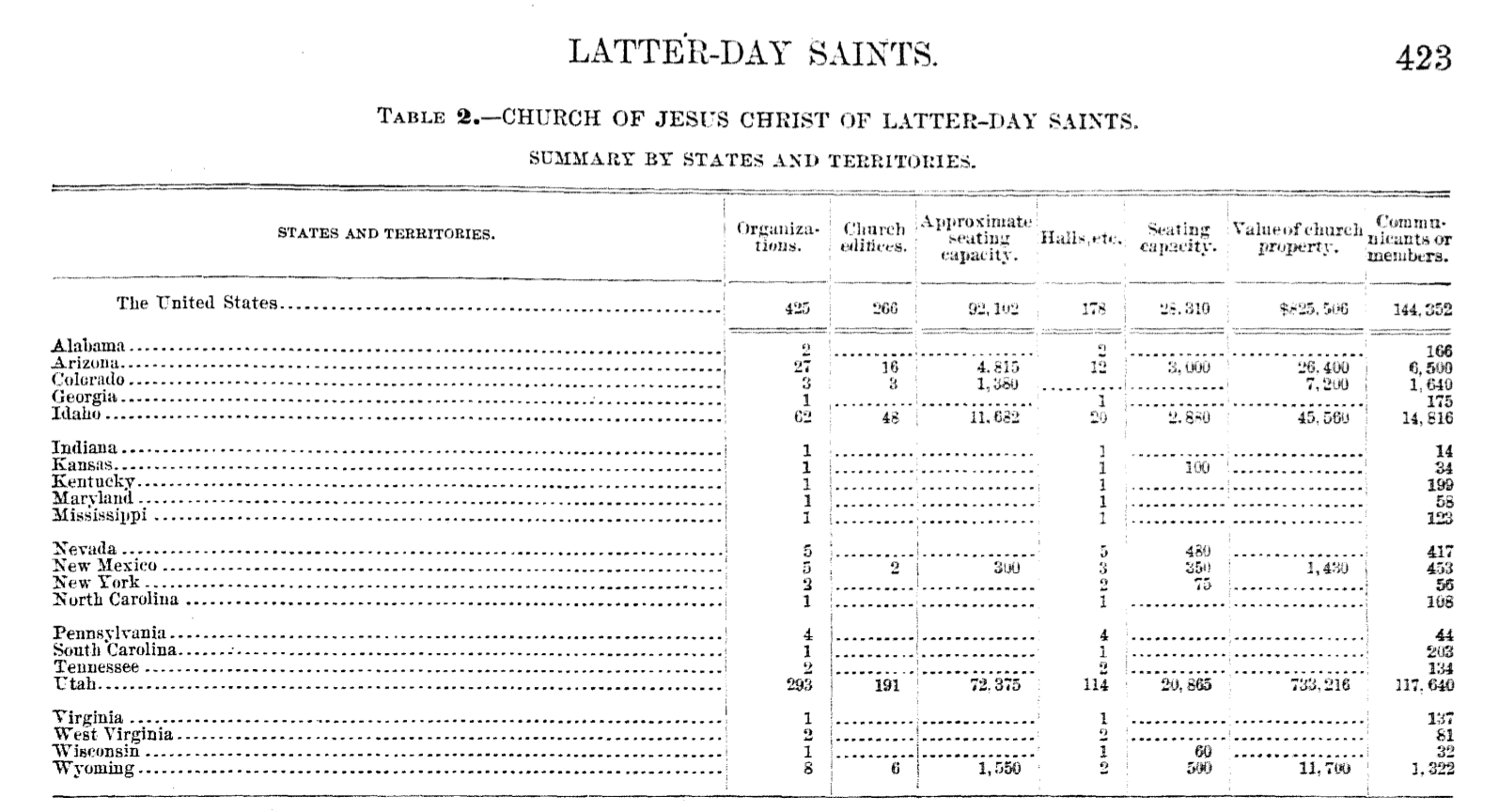
A better table is this one from that same report:
This table summarizes the number of Mormons by state. The bulk are in Utah and the surrounding states, but it does give a pretty good estimate of the number of Mormons in the US in 1890 – 144,352. The LDS Church reports 188,263 members that year, suggesting roughly 76% of Mormons live in the US in 1890, and 62% lived in Utah.
I checked the other censuses prior to 1900 and they do not have reports on religious affiliation. They do, however, have information on death rates. If you use Utah as a proxy for Mormons around that time, this may prove useful. Each of the Censuses is available on the census bureau’s website, starting with 1850, when Mormons were beginning to locate in Utah. See here. Another resource that may prove useful is the Statistical Abstract of the United States, which aggregates a variety of information. A quick perusal of some of the Abstracts prior to 1900 suggest they only have information on the population of Utah, but not on vital statistics. Later abstracts added additional information about populations, so you may find these more useful after the turn of the century.
Q: I was wondering if the Church has a specific meta-theory they employ when doing research? Is it perhaps mostly pragmatic for the case at hand? Or that the choice of meta-theory the researchers apply is up to themselves? Or is it just implicitly positvist?
A: Armand Mauss responded:
My knowledge and experience with the Research Information Division (now very far out of date) has suggested to me that the RID staff are engaged mainly in so-called “evaluation research,” which tends to be a-theoretical, no matter which institution is doing it. Meanwhile, on the basis of some of my own earlier experience, here is an excerpt from my forthcoming memoirs that might be relevant to the question:
A person at the managerial level in the RID once offered me a revealing anecdote, which might be apocryphal, at least in part, but nevertheless illustrative: During preparations for a major longitudinal research project on conversion and retention, the in-house research team was asked for a progress report by Elder Bruce R.McConkie, one of the most conservative apostles. After he had listened to a recital of all of the variables that were to be measured as “predictors” of an investigator’s ultimate conversion, McConkie responded (in effect), “Well, all this talk about variables that will predict conversion is very interesting, but where in the conversion process have you made room for the influence of the Holy Ghost, which Moroni teaches is the power that really does the converting?” One of the researchers might have anticipated such a question, for he quickly replied (in effect), “Moroni instructs those who receive the teachings of the Book of Mormon to seek the confirmation of the Holy Ghost after they have pondered and prayed, and what we are studying as social scientists is the process that gets investigators to the point where they are motivated to ponder and pray for divine confirmation.” This partnership between research and revelation seemed to satisfy the apostle, and it illustrates well the pragmatic Mormon approach to managing the tension between the two in Church governance more generally.
Q: According to the Pew center, 32 percent of U.S. Mormons have “some college education.” This is the highest percentage I know of for any denomination (including non-Christian ones). However, only 18 percent have graduated from the college level (and 11 percent from a graduate education). Both of *these* figures, while still above the national percentage, Latter-day Saints are notably outperformed by Hindus and Buddhist (which may reflect the demographics of their emmigration), Jews, Orthodox Catholics, and the mainline denominations. Latter-day Saints tie with Roman Catholics and only outperform Evangelicals, historic Black churches, and Jehovah’s Witnesses. How is the LDS lack of completing their higher education best explained?
A: Several members of the MSSA responded with information to answer this question. However, it is worth noting that, while the question asked about college non-completion rates for Mormons generally, all of the experts below noted that this is likely tied to gender differences in college attendance.
Rick Phillips made an important point about the nature of the Pew data:
This is another example of how findings from Pew’s study are skewed because they oversampled counties in Utah. The trend of women dropping out of college and the low percentage of Utah college students that are female does not square with the ARIS’s more representative sample, which shows no significant difference in the number of LDS men vs. women who have a college degree. Note as well that ARIS shows that significantly more LDS women in Utah than LDS women elsewhere are stay at home moms, so Pew is documenting a Utah Mormon phenomenon that is not as pronounced in the total U.S. LDS population.
Sherry Baker noted that Susan R. Madsen and colleagues, from Utah Valley University, have done extensive research on why young women in Utah are not attending and completing college at the same rates as young women outside Utah. In one of the reports that was published based on that research, Dr. Madsen and her co-authors note that there is a connection to Mormon men serving missions. This is reflected in the odd disparities in college attendance rates in Utah by age and sex. At younger ages, women are closer to national averages in college enrollment, but that changes at older ages. Dr. Madsen and colleagues suggest that what is driving this is Mormon men returning from missions, who then enroll in college. The influx of returning Mormon missionaries would dilute the number of young women in college. However, their study also finds that young women in Utah are dropping out after their first one or two years. While it is not explicitly stated in Dr. Madsen’s research, the implicit suggestion is that women drop out after they find a husband to marry, probably a returned missionary. She also notes that women in Utah major in low-paying, low-skill areas, like education, and are substantially under-represented in higher-paying majors like business and STEM disciplines. Despite the above findings, in one of the reports, Dr. Madsen and colleagues conclude that devout female members of the LDS Church are encouraged to get a college education and seem to suggest that being LDS encourages college participation, rather than discouraging it. This may be a case where explicit directives on the topic of education from the leadership of the LDS Church suggest one thing – college education is important for women – but many implicit directives in other areas end up pushing women away from completing college. This is well-illustrated by another of Dr. Madsen and colleagues findings that Utah women have traditionally been better educated than the national average, but that historical pattern began to shift in 1993 and by 2000 Utah women were below average. The Proclamation on the Family was released in 1995, and it says,
“By divine design, fathers are to preside over their families in love and righteousness and are responsible to provide the necessities of life and protection for their families. Mothers are primarily responsible for the nurture of their children. In these sacred responsibilities, fathers and mothers are obligated to help one another as equal partners. Disability, death, or other circumstances may necessitate individual adaptation. Extended families should lend support when needed.” (full text here)
In other words, Mormon women are told to get college educations but are also told that their place is in the home, taking care of kids. The high rate of college non-completion is likely a result of the mixed messages these women receive.
Armand Mauss suggested that it would be difficult to arrive at a a definitive answer on this question without controlling for other variables:
I don’t think we can make much of such general figures without controls at least for age and for convert vs. lifer. Over the years, my impression from various data sets has been that the LDS Church tends to convert people of mainly modest education, who then produce children of much higher educational attainment.
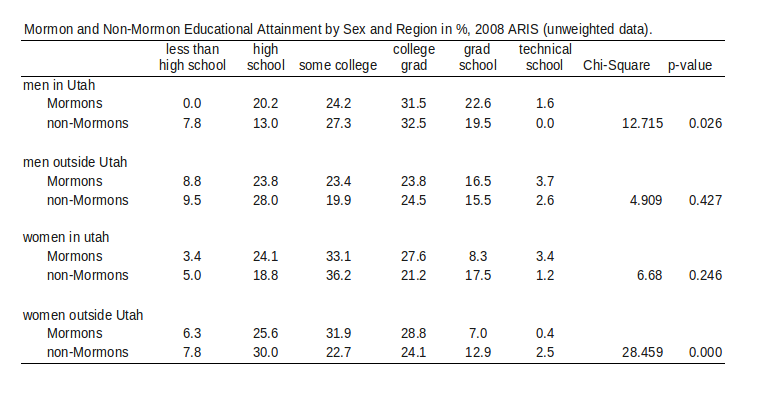
In the interest of pursuing Dr. Mauss’s suggestion, I (Ryan Cragun), re-examined ARIS 2008 data to see what it can tell us about the educational attainment of Mormon men and women. To begin with, Mormon men in Utah do have significantly more education than do non-Mormon men in Utah. However, outside Utah, Mormon men do not have significantly more education than do non-Mormon men. For Mormon women there is a slightly different pattern. Inside Utah, Mormon women do not have significantly different educational attainment than do non-Mormon women; outside Utah Mormon women have significantly less education than do non-Mormon women. These findings are detailed in the table below:
(click for full resolution)
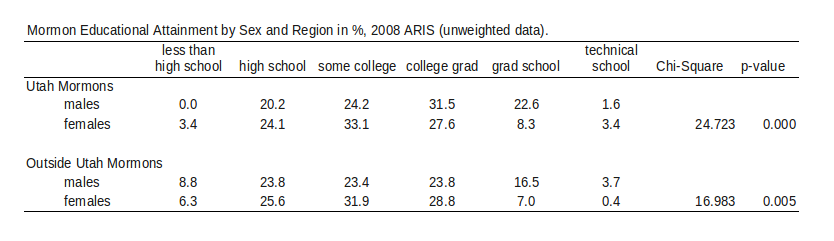
As far as Mormon men vs. Mormon women goes, Mormon men do have significantly more education on average, but most of that education is at the upper end. There are negligible differences in college graduation rates across all Mormon men (26.2%) and women (28.4%), but Mormon men are substantially more likely to have graduate degrees (18.4%) than are Mormon women (7.4%). Also, Mormon women are more likely to have some college (32.3%) than are Mormon men (23.7), suggesting there is a phenomenon of Mormon women dropping out of college, probably once they find a husband. This data is shown in the table below:
(click for full resolution)
However, there is a difference in educational attainment between Mormon men and women depending on where they live. Mormon women outside Utah are more likely to have completed college than are Mormon men, but less likely inside Utah. In both places, however, women are more likely to have some college than are men, as shown in the table below:
(click for full resolution)
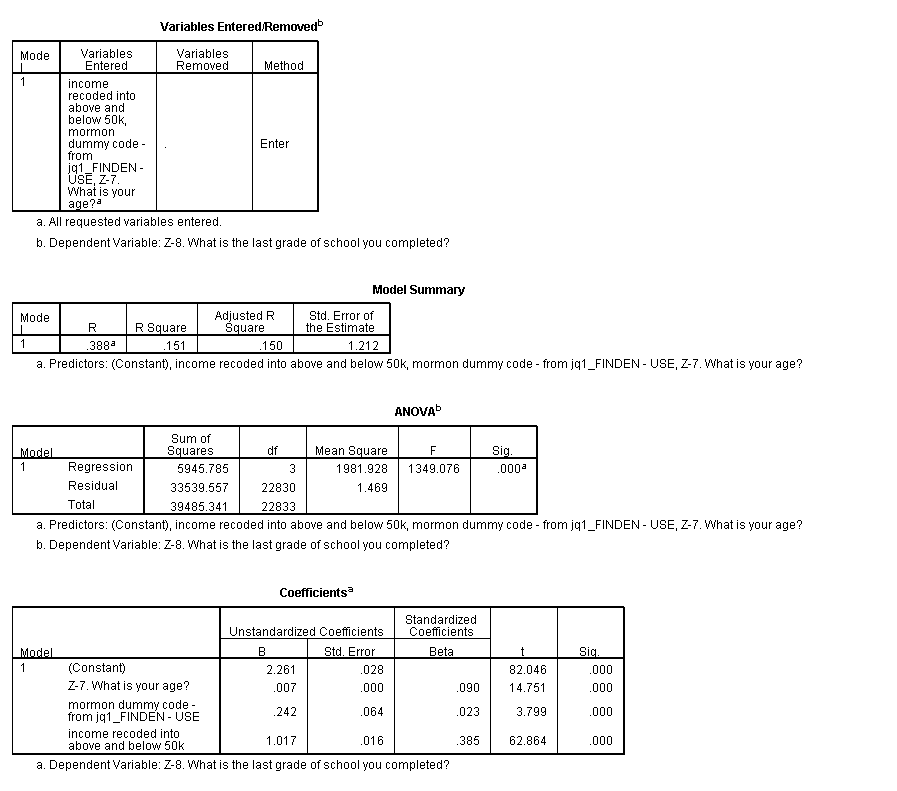
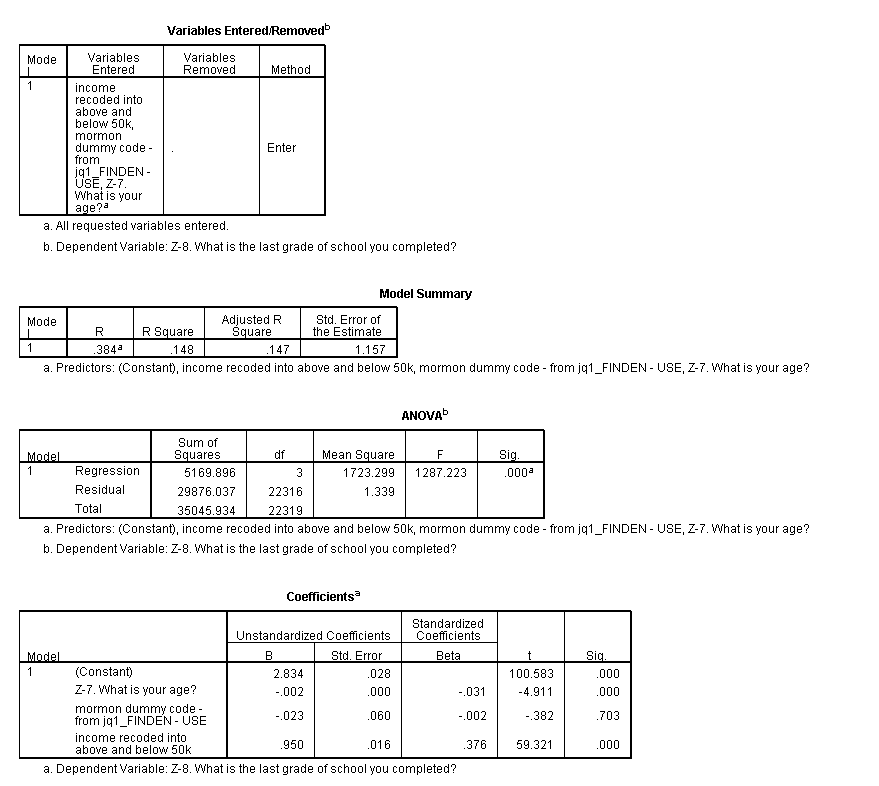
Finally, in an effort to more directly address Dr. Mauss’s point about controlling for age (convert status is not included in ARIS 2008), I ran two regressions. The dependent variable was educational attainment with the categories shown in the above tables (technically an ordinal variable, but used here as an interval-like variable). Educational attainment was regressed on (1) age, (2) whether or not the respondent is a Mormon (0=not Mormon; 1=Mormon), and (3) income (dummy coded as below $50,000 per year=0; above $50,000 per year=1).
The first regression included just the male participants in ARIS 2008. All three variables in the equation are significant. As age increases, educational attainment increases for Mormon men. Being Mormon increases educational attainment for Mormon men. And having more than $50,000 per year increases educational attainment (causality on this last one is, of course, tricky). Here are the results:
(click for full resolution)
The second regression included just the female participants in ARIS 2008. Income is positively correlated with educational attainment. Age and being Mormon, however, are inversely correlated with educational attainment, though the dummy code for being Mormon is not significant. Here are the results:
(click for full resolution)
In other words, even when you control for age and income, only men see educational benefits from “being Mormon”; Mormon women do not.
In the United States in the late twentieth century, LDS members have higher rates of marriage and lower rates of marital dissolution than the national population (see Divorce; Marriage). Marriage patterns vary in different areas of the Church (Fig. 15). Marriages performed in LDS temples are the LDS ideal. The percentage of adults in a temple marriage varies from about 45 percent in Utah to less than 2 percent in Mexico and Central America. Temple marriage is relatively common among Latter-day Saints throughout the United States and Canada but is relatively rare in other areas of the world. Marriage outside the temple is about as frequent as temple marriage and is the most common form of marriage outside the United States and Canada. In some areas, a significant minority of marriages involve one partner who is LDS and another who is not. These interfaith marriages involve only about 5 percent of the membership in Utah, Mexico, and Central America, but reach nearly 20 percent in other parts of the United States and in Canada. There are more than twice as many LDS women as LDS men married to spouses of another faith…. The distribution of households does not fit any uniform pattern across countries. The idealized vision of a family with a husband and wife married in the temple and children present describes only one out of five LDS families in the United States and less than 3 percent of LDS families in Japan.
Based on the above information, it is highly unlikely that the percentage of Mormons who regularly participate in temple worship could be above 50% and is likely somewhat below 50%.
David Stewart offered the following response:
The recent Pew Research Center study (“Mormons in America,” 12 January 2012) surveyed 1,019 Mormon adults in the US by phone. Their methodology involved “oversampling of certain regions of the country where Mormons are most numerous” (p. 67). The authors also note that sampling was not random and involved re-contacting Mormons identified on prior Pew surveys (p.67) to better represent LDS populations in areas where Latter-day Saints constitute a small minority. The Pew study found that 65% of Mormon adults surveyed claimed to hold a current temple recommend. However, this result must be interpreted with several important caveats:
Religious affiliation was based on self-identified religious preference rather than on a statistical sampling of church membership records. The Pew study misses individuals who no longer consider themselves Mormons but are still counted as members by the LDS Church. The results are relevant for self-identified Mormons, but cannot be extrapolated to overall membership figures, which include large numbers of disaffiliated individuals who no longer identify the LDS Church as their faith of preference.
LDS member activity rates in North America are known to be in the 40-50% range, with many semi-actives included in that figure (see here), whereas 77% of Mormon respondents on the Pew survey claim to attend church at least once weekly. Again, the Pew study heavily oversamples the most active Mormons while undersampling less-active or disaffiliated members (precisely because such individuals are less likely to identify themselves as Mormons).
Prior Pew studies, which served as a basis for re-contacting prior Mormon respondents, have demonstrated a skew not representative of the overall LDS population as claimed on church records. For instance, the 2008 Pew Forum Religious Landscape Study reported that only 23.5% of self-identified US Mormons were converts, whereas cumulative demographic data, birth rates, and historical convert baptism rates all suggest that converts should comprise at least 50% of North American LDS membership. This discrepancy correlates with other data suggesting that at least half of North American converts have become disaffiliated. I have dealt with several additional methodological issues with prior Pew survey here. Another way to look at these sampling issues is to observe that in contrast to traditions such as Catholicism where individuals may strongly identify with the faith without actively participating, LDS membership is more polarized between active members who identify themselves as Mormons and non-participating members who no longer consider the LDS Church their faith of preference, with only a relatively narrow stratum (primarily in the “Mormon Cultural Region”) of individuals who identify themselves as Mormons but do not regularly participate.
Self-reported data among US Christians has widely been found to over-report perceived desirable religious behaviors on matters such as church attendance (38-44% of Americans claim to attend church weekly but only about half are actually there) and tithing (nearly three times as many American Christians claim to tithe as actually do so; see here). It is a bit of a running joke, and not without evidence, to state that when people tell you how much they drink or smoke, you double it; when people tell you how much they go to church, you cut it in half. While one hopes that Latter-day Saints may be more candid in self-reporting their behaviors than their neighbors of other faiths, it seems unlikely that studies of Mormons are totally exempt from the over-reporting of religious behaviors. Indeed, the same current Pew study that claims that 65% of Mormon adults hold a temple recommend also found that 79% of Mormons claim to pay a full tithe and only 1% are partial tithe payers (Pew p.39). I do not believe that this finding is likely to be considered credible by anyone who has served in a LDS bishopric or as a ward clerk.
The study only refers to US Mormons. International LDS members demonstrate significantly lower overall participation and temple attendance rates than US members (references above); US data cannot be extrapolated to the worldwide church.
So how many Mormons attend the temple regularly? The LDS Church does not release specific data, but what we know about activity rates and member participation can reasonably suggest upper and lower brackets. With LDS activity at about 40-50% in North America and 65% of self-identified Mormons claiming to have a temple recommend (remembering that most non-participating Mormons do not identify themselves as Mormons, and that perceived desirable religious behaviors seem to be significantly exaggerated), it is difficult for me to see a figure above one-third of LDS adults holding an active temple recommend as realistic, and the actual the number may be slightly less. It is also generally known that only some fraction of recommend holders attend regularly (anecdotally perhaps one third or fourth, although I have no certain idea). Overall international rates are likely to be not more than half of U.S. rates, given the preponderance of LDS membership in nations with relatively low activity rates (detailed country reports here).
Armand Mauss wrote in response to this question as well, noting:
I have no systematic data on this subject. However, during the past two decades I have had callings in several western wards that have permitted me to know how many ward members held recommends, and I have compared notes with friends in other wards having similar first-hand knowledge. From these experiences, I would say that the proportion of LDS adults holding temple recommends is closer to 1/3 than to 2/3, at least in the American west.
Finally, Cardell Jacobson wrote a response as well:
I would just point out that there is a great deal of variation within the United States. The core of the LDS Church, of course, remains along the Wasatch front (in Utah), but also parts of Arizona, Idaho, Alberta, and some areas of California. In other areas, the numbers of temple recommend holders, tithe-payers, attenders, etc. are far less than in the core.
Based on the above information, it seems likely that the highest rates of temple attendance among Mormons are in the Mormon heartland – the Wasatch Front and other parts of the Intermountain West. The percentage of Mormons who regularly participate in temple worship in that Mormon heartland is unlikely to be as high as the percentage noted in the 2012 Pew Survey – 65%. Given the methodology of the survey, that number appears to reflect the behaviors of highly engaged Mormons. The other data provided above suggest that the real number is much lower than the Pew number, perhaps as few as 25% in the U.S. and much lower outside the U.S., but an exact number isn’t known.
Q: I am specifically interested in whether there have been studies on those who have converted out of Mormonism in terms of how this breaks down statistically in terms of lifelong members vs. converts. Are lifelong members less likely to leave vs. others?
A: Rick Phillips kindly provided an extensive response to this question. He wrote:
In the 80s, using proprietary LDS data, Stan Albrecht found that converts were at greater risk of defection, and that the risk was highest in the first five years after conversion. Here is the citation:
Stan L. Albrecht, “The Consequential Dimension of Mormon Religiosity,” in Latter-day Saint Social Life: Social Research on the LDS Church and its Members, ed. James B. Duke (Provo, UT: Religious Studies Center, Brigham Young University, 1998), 273.
A few years ago, I published an article showing that nations with high growth rates have a high disparity between the number of people on LDS church rolls, and the number of people who claim to be LDS on national censuses. This implies that new converts are at much higher risk of defection. Here is the citation:
Rick Phillips “Rethinking the International Expansion of Mormonism” Nova Religio: The Journal of New and Emergent Religions 65 no. 2 (2006) 52–68.
These findings coincide with anecdotal reports and newspaper accounts of GA statements on the subject from this time frame. Thus, for the worldwide church, I think it is very safe to say that converts are at higher risk of defection than lifelong members.
The situation in the United States is a bit different. In a forthcoming article, Ryan Cragun and I show that until about 1995, converts were more likely to defect than lifelong LDS. However, as the demographic base that undergirds Mormonism in UT and the intermountain west begins to erode, this difference has been erased. Now defections are equally likely among lifelong members and converts, at least in the US. The article is entitled “Contemporary Mormon Religiosity and the Legacy of ‘Gathering,’” due out in the journal Nova Religio.
Finally, in a report that Ryan Cragun and I are writing, we use data from the American Religious Identification Survey to infer that defections from the faith in Utah are increasing, and that young men are at greatest risk of falling away. The male to female ratio among self-identified Mormons in Utah is now 2:3. This report is not quite finished yet, but it will be released soon.
Q: (1) What percentage of the Utah population is LDS and what percentage is evangelical and, (2) how have these percentages changed over time? (3) Which evangelical denominations are present in Utah.
Answer:
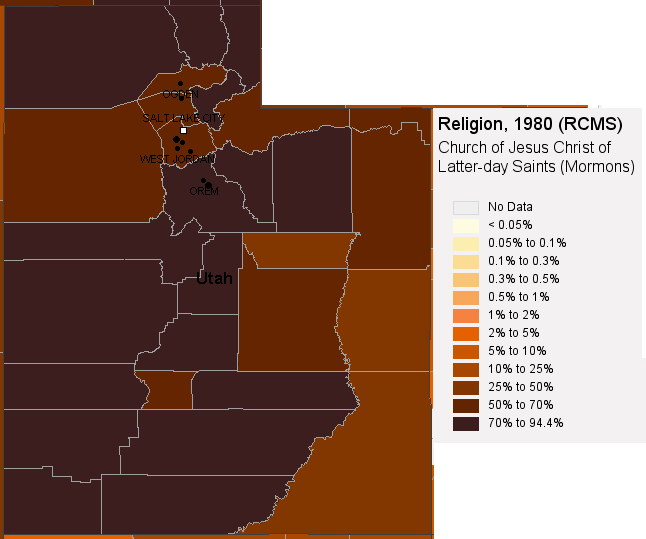
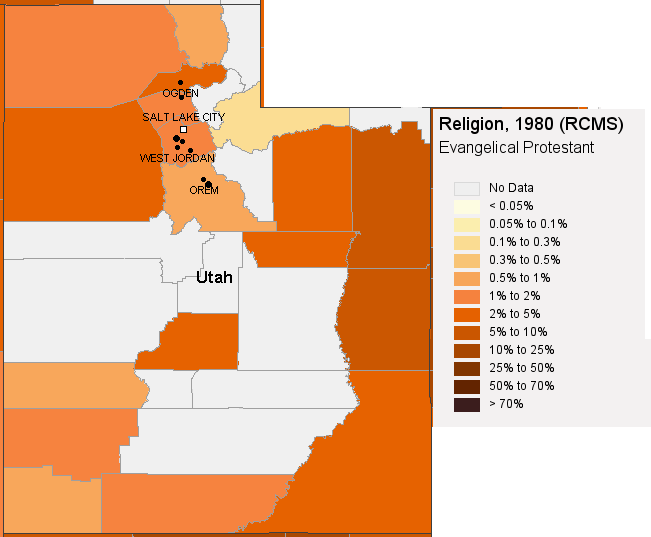
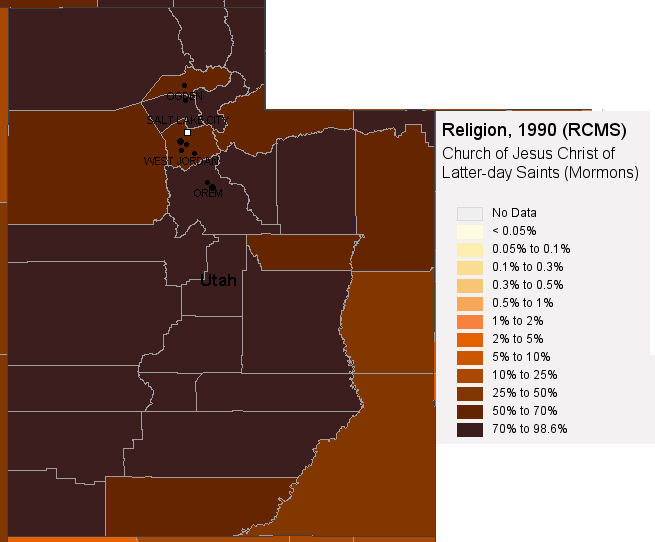
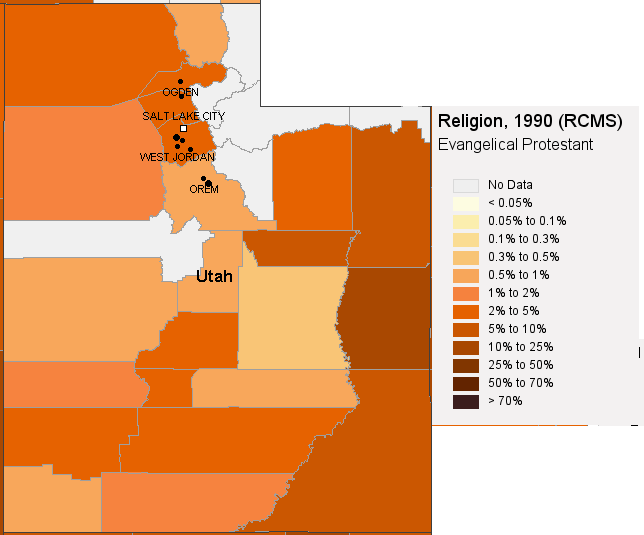
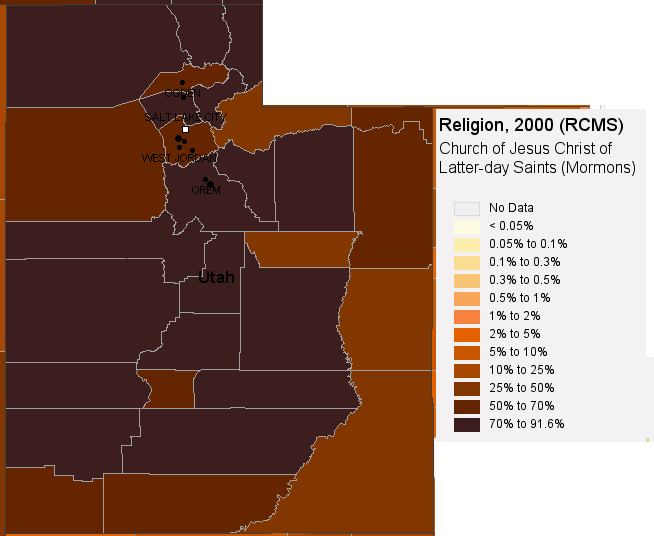
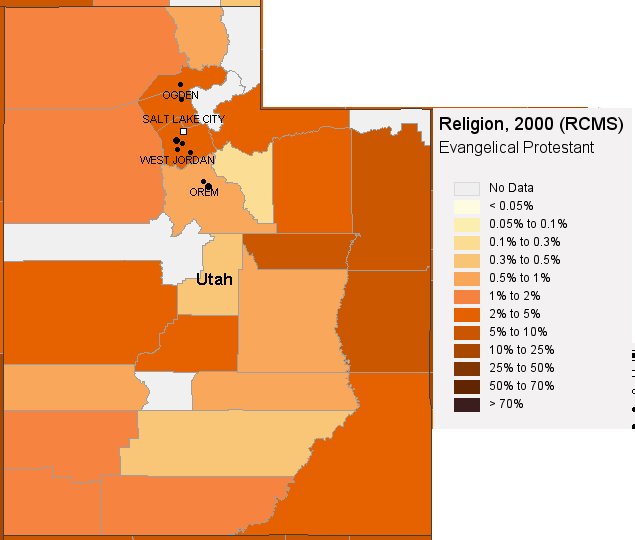
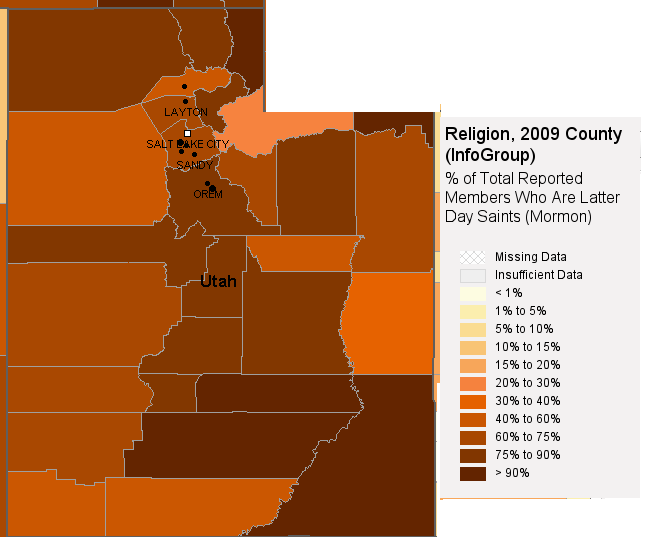
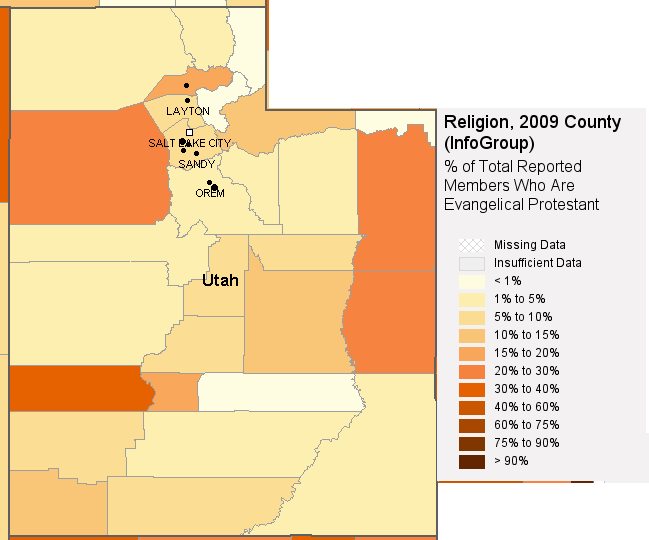
Rick Phillips, Andrew Miles, and Armand Mauss all wrote in to suggest that the questioner peruse the American Religion Data Archive (ARDA) for this information. Below are some maps generated using the ARDA website that illustrate the percentages Mormon and Evangelical by counties in Utah in 1980, 1990, 2000, and 2009.
% Mormon - 1980 (click for full size)
% Evangelical - 1980 (click for full size)
Mormons - 1990 (click for full size)
Evangelicals - 1990 (click for full size)
Mormons - 2000 (click for full size)
Evangelicals - 2000 (click for full size)
Mormons - 2009 (click for full size)
Evangelicals - 2009 (click for full size)
These maps were generated here. The maps do indicate a declining percentage Mormon in some counties and an increasing percentage Evangelical Protestant.
The ARDA also includes a table with specific information on denominations in Utah in 2000 (see here). According to that table, there were 42,420 Evangelical Protestants in Utah in 2000 and 1,483,858 Mormons/LDS. This table reports 1990 membership information. In 1990 there were 38,137 Evangelical Protestants and 1,236,242 Mormons/LDS. Finally, this table reports the 1980 membership information. In 1980 there were 23,464 Evangelical Protestants and 985,070 Mormons/LDS. These numbers suggest a 51% increase in members for Mormons/LDS and an 81% increase in members for Evangelical Protestants. These percentages suggest Evangelical Protestants are growing more rapidly relative to their size, but in absolute members the Mormons/LDS Church is growing more rapidly.
Finally, the 2000 table also provides a list of Evangelical Protestant denominations with members in Utah, though they vary in size substantially:
American Baptist Association, The
Apostolic Christian Churches (Nazarene)
Assemblies of God
Calvary Chapel Fellowship Churches
Christian and Missionary Alliance, The
Christian Churches and Churches of Christ
Christian Reformed Church in North America
Church of God (Cleveland, Tennessee)
Church of God of Prophecy
Church of the Nazarene
Churches of Christ
Community of Christ
Conservative Baptist Association of America
Evangelical Free Church of America, The
General Association of Regular Baptist Churches
Independent, Charismatic Churches
International Church of the Foursquare Gospel
International Churches of Christ
International Pentecostal Holiness Church
Lutheran Church–Missouri Synod
Mennonite Brethren Churches, U.S. Conference of
Mennonite; Other Groups
National Association of Free Will Baptists
Orthodox Presbyterian Church, The
Pentecostal Church of God
Presbyterian Church in America
Salvation Army, The
Seventh-day Adventist Church
Southern Baptist Convention
Southwide Baptist Fellowship
Vineyard USA
Wisconsin Evangelical Lutheran Synod
Rick Phillips also suggested the following articles from the Salt Lake Tribune:
Q: I am frustrated because lots of searching through the books I have, including the Mormon Encyclopedia, is not telling me when the program of using youthful males as missionaries became the norm within Mormonism. An article in the Encyclopedia mentions that initially the missionaries were usually married men who left their families for an unknown period. I know that the earlier format for studies with people by the young missionaries was published about 1960. But when did the two-by-two youthful ones originate, and what were the patterns between the “first generation” married men and the when the study format was published? If you know the answers to this set of questions I would be most grateful to have them, please.
A: Several members of the MSSA responded to this question.
Jan Shipps wrote:
In my own general research, the first mention I saw of the shift to young men came not long before World War II. I know that at the first of the war in Europe, the First Presidency was very much concerned about making sure that the American missionaries in Germany and other parts of continent could get home safely. There were lots of questions about whether missionaries would be drafted during World War II. But that does not tell us a lot.
My mother was a missionary in the Northern States Mission around 1953, 54. She said there were a few married elders, called because of Korea. But she understood that was the last of them, and that early on the McKay Administration decided to end the calling of married brethren to serve missions. I am not sure on what basis she said that (she is now deceased)–whether it was common knowledge, or whether she learned from President McKay himself or his son, who was my mother’s uncle.
Q: I’m about to begin an honors thesis in psychology and am interested in using an LDS sample. I’m not abreast of the literature, and was wondering if there were some interesting findings in the research examining latter-day saints? Perhaps you could point me to a good review? Alternatively and probably more useful, have you as an expert researcher identified any anomalies or gaps in LDS research? Another way of looking at this may be – if you yourself could have a psychological study done examining some aspect of Mormons, what would you be most interested in examining? Any suggestions no matter how vague or fantastic would be really appreciated. Lastly, I have leanings myself towards studying recently returned missionaries on some aspect of adjustment/subsyndromal PTSD. Potentially with a view to proposing a sort of “RM-MTC” for vulnerable rm’s.
I’m wondering how feasible this research proposal sounds, or if anything like this has been done with missionaries in the past, and whether the church needs to approve a study such as this…
A: Here are the answers from the MSSA…
Michael Nielsen offered the following:
There is very little psychological work examining post-mission life, or even mission life, for that matter. I recall a few articles dealing with this topic in general. I’d encourage you to consider framing it as post-mission adjustment, or something similar, rather than PTSD, as PTSD will likely be perceived by some who could benefit from the research as denigrating the mission experience, or as suggesting a prejudice against missions even if it is not intended. This can adversely affect your ability to get a good sample, as well as the potential to publish the results later. If your library has access to the PsycInfo database, you may be able to locate helpful studies by combining “religio*” and “adjustment”, and narrowing down the resulting list. Don’t include LDS or Mormon unless you really need to focus on specifically Mormon elements. You might also try the Sommervogel Archive (http://www.division36.org/sommervogel.html), which is an index of religion research that has little overlap with the PsychInfo database. (For instance, searching Mormon in Sommerogel yields results from religion journals, sunstone, and other things not indexed in PsycInfo.) By maintaining a sufficiently broad conceptual base, not limiting your research to Mormonism specifically, you should be able to find a good body of literature to build on.
Armand Mauss offered the following:
Here are some suggestions, whether or not you are able to do a survey for your honors thesis:
1) Get a copy of the large bibliography, Studies in Mormon History, 1830-1997, compiled by Allen, Walker, and Whittaker (U. of Illinois Press, 2000), and go to the final section, “A Topical Guide to Published Social Science Literature,” where you will find an overview of what sociological and psychological studies have been done (up to about a decade ago). Some of these works were based on surveys but most were not. Nevertheless, you can see what sorts of topics have already been addressed. Some studies of missionaries are included.
2) Get a copy of Heaton, Bahr, and Jacobson, A Statistical Profile of Mormons: Health, Wealth, and Social Life (Edwin Mellen Press, 2004). From this book you can see what survey data sets are in the public domain and potentially available for secondary analysis. Most of them require the researcher to cull out Mormon subsamples from the larger data sets. Heaton et al. can probably tell him how to do this, and how to get access to the data sets. They might already be on file at BYU.
3) Go to the ARDA website and see what kinds of data are available on Mormons in that archive. My own 40-year-old surveys are on file there, which could at least give him examples of the kinds of questions that have been successfully used in studying Mormon populations. Other ARDA data sets contain LDS data aggregated at the congregational or county level, etc. See this and this.
4) Finally, it might be in your interest to contact the Research Information Division (RID) in Salt Lake City to see if they have any leads for him. Their own data would be proprietary, but they might be able to point him to studies they know of that would be available to him. I know, for example, that RID participated in the recent Congregational Surveys done by the Hartford Seminary (which I think are included in the ARDA archive), so even RID data collected for those surveys might be available. (If you want contact information for some of the RID researchers, let me know.)
Andrew Miles offered the following:
Glad to hear you are interested in studying Mormons! In my experience, there aren’t that many social scientific studies specifically about Mormons, though that has been changing in recent years. The problem is that most big data sets have very few Latter-day Saints in them, and so researchers on religion usually can’t look at patterns for LDS apart from other religious groups. That means that whatever you do, you’ll probably have to collect your own data.
In terms of gaps in the literature . . . Well, most research that I’m familiar with on Mormons is historical or cultural. That means that most psychological or social psychological questions that might be unique to Mormons probably have not been explored. I think you could expand your RM study to include other stressors as well. For instance, being single in a family-oriented church might be seen as a type of chronic stressor, and being called into a demanding church position such as bishop or stake president might similarly provoke stress. These could lead to psychological distress, but might also be counterbalanced by support and coping resources that exist in the LDS church as well. If you wanted to take a comparative approach, you could look at mental health among LDS and another religious (or non-religious) group.
Q: I was wondering if you might be able to send me some information on where I can find empirical studies and data, so that I may further my research. I want to focus on African American women challenges of being Mormon, and how traditional (black) practices and customs differ from that of Mormon culture. I was wondering if you might be able to send me some information on where I can find empirical studies and data, so that I may further my research. I want to focus on African American women challenges of being Mormon, and how traditional (black) practices and customs differ from that of Mormon culture.
A: Two members of the MSSA responded to this question.
Armand Mauss suggested the following:
I would refer Teameaka to the websites www.blacklds.org and www.ldsgenesisgroup.org to start with, so that she can explore what resources and contacts she might encounter there. Then for knowledgeable individual people, she should contact the following:
Lillian Glover (lglover318@yahoo.com), who is coordinator for African American Affairs in southern California
Marvin Perkins (perkinsmc@sbcglobal.net), who has his own Outreach Program for LDS African Americans
Margaret Young (margaret_young@byu.edu), who (with Darius Gray) is author of a trilogy that explores the history of LDS African Americans, including a number of women, such as Jane Manning James.
Other resources :
The hour-long PBS documentary “Nobody Knows” deals with the history of African American Mormons, based on the research of Margaret and Darius. Margaret can tell Teameaka how to get access to that documentary.
The BYU Redd Center for Western Studies has a collection of more than 200 “oral histories” transcribed during the 1980s from interviews with black LDS members, men and women.
Professor Stephen C. Finley (scfinley@lsu.edu ), a young professor of Religious Studies at Louisiana State University is just starting a book project on black Latter-day Saints and how they articulate their ethnic and religious identities. He has been collecting data from various sources, including the libraries in Utah, and is very knowledgeable about them. I think he would be very helpful, and there might be opportunities for collaboration there (he is black but not LDS).
Anyway, all that would be a good start. I don’t know of any special sources about LDS African American women, but these sources I have mentioned would include material on women, as well as on men.